European Russia (1900)
Files
Title:
European Russia (1900)
Subject:
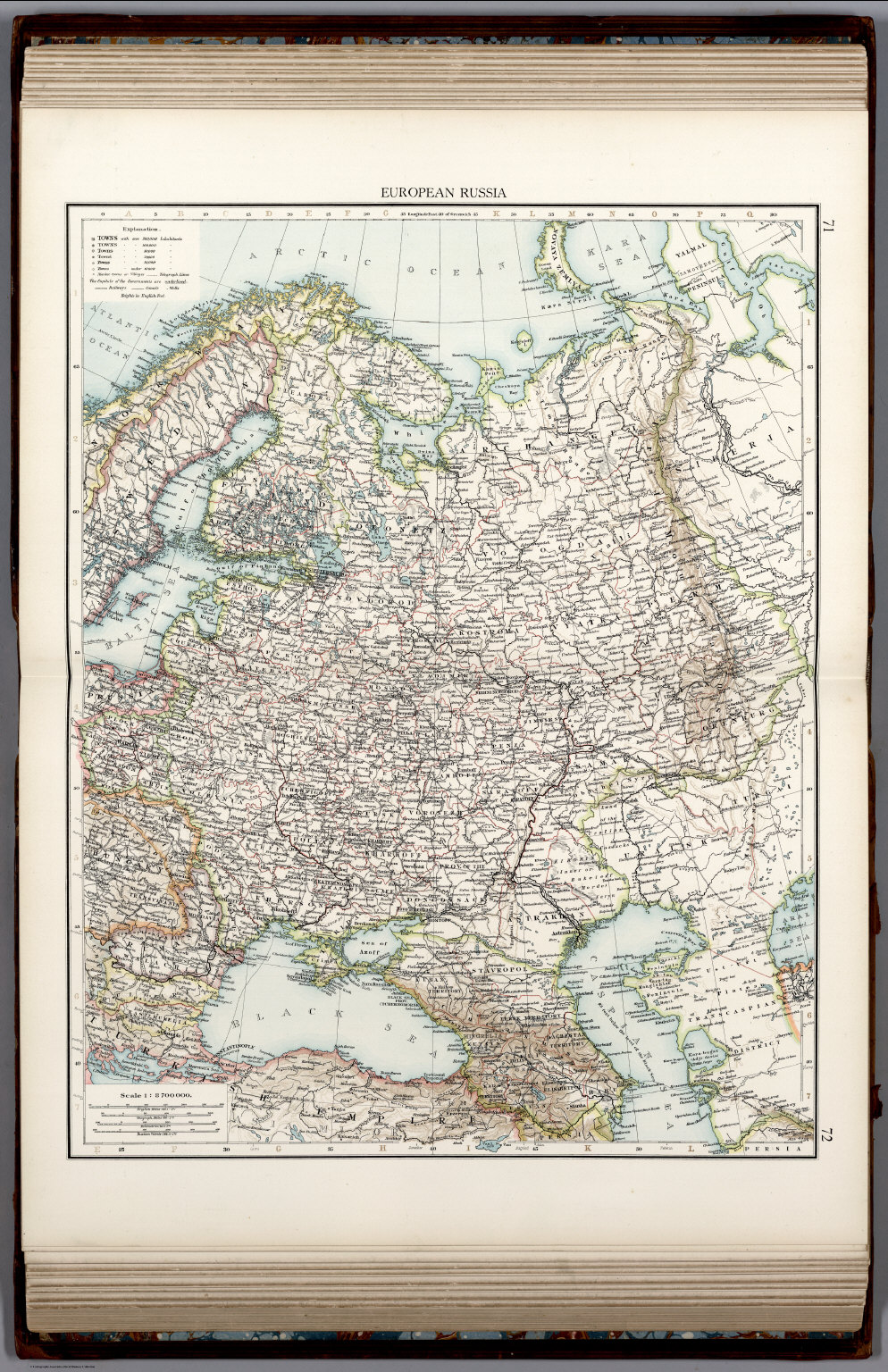
Map of European Russia
Description:
This map of European Russia was created by German geographer and cartographer Richard Andree (1835 - 1912). Interestingly, Andree was the son of another well-known and much respected 19th Century German geographer, Karl Andree (1808 - 1875). During his lifetime, Andree’s primary concentration was ethnographic studies, but he is perhaps best known for producing the Andrees Allgemeiner Handatlas (Andree’s General Atlas), a popular world atlas first published in 1881 and last published 25 years after his death (1937).
This particular map reflects that of European Russia; authored by Andree and published by the Office of The Times (London) in 1900. This map is important because it defines the area comprising European Russia roughly at the time of the Russian Cholera Epidemic of 1892. Also, this map shows the locations of cities/towns and the primary sources or lines of human communication and/or contact between population centers.
Additionally, this map shows the location of natural resources (e.g., fresh water sources – lakes, wells), as European cartographers would have understood it prior to the turn of the 20th Century. This is important, because access to clean/fresh water would have likely been a mitigation technique to reduce the spread of pathogenic microorganisms that caused (and continue to cause) waterborne illnesses (i.e., cholera).
Because this map comprises the entirety of European Russia east to the Urals and southeast to the Transcaspian region, it is useful in tracking (i.e., date & timestamping) the spread of cholera in Russia, in the year 1892, as described by Dr. Frank Clemcow’s in his article: The cholera epidemic of 1892 in the Russian empire. Furthermore, the locations and features on this map most likely reflect Clemcow’s understanding of the environment during the period of his research 1892-1893. One can follow the lines of communication, quite literally, from the epidemic’s origin in the southwest and chart the disease’s likely vector(s) to the northwest corner of the empire. This map also provides a distinction of available water sources by location.
Creator:
Andree, Richard
Source:
David Rumsey Historical Map Collection
Publisher:
The Office of The Times (London, England)
Date:
1900
Language:
English