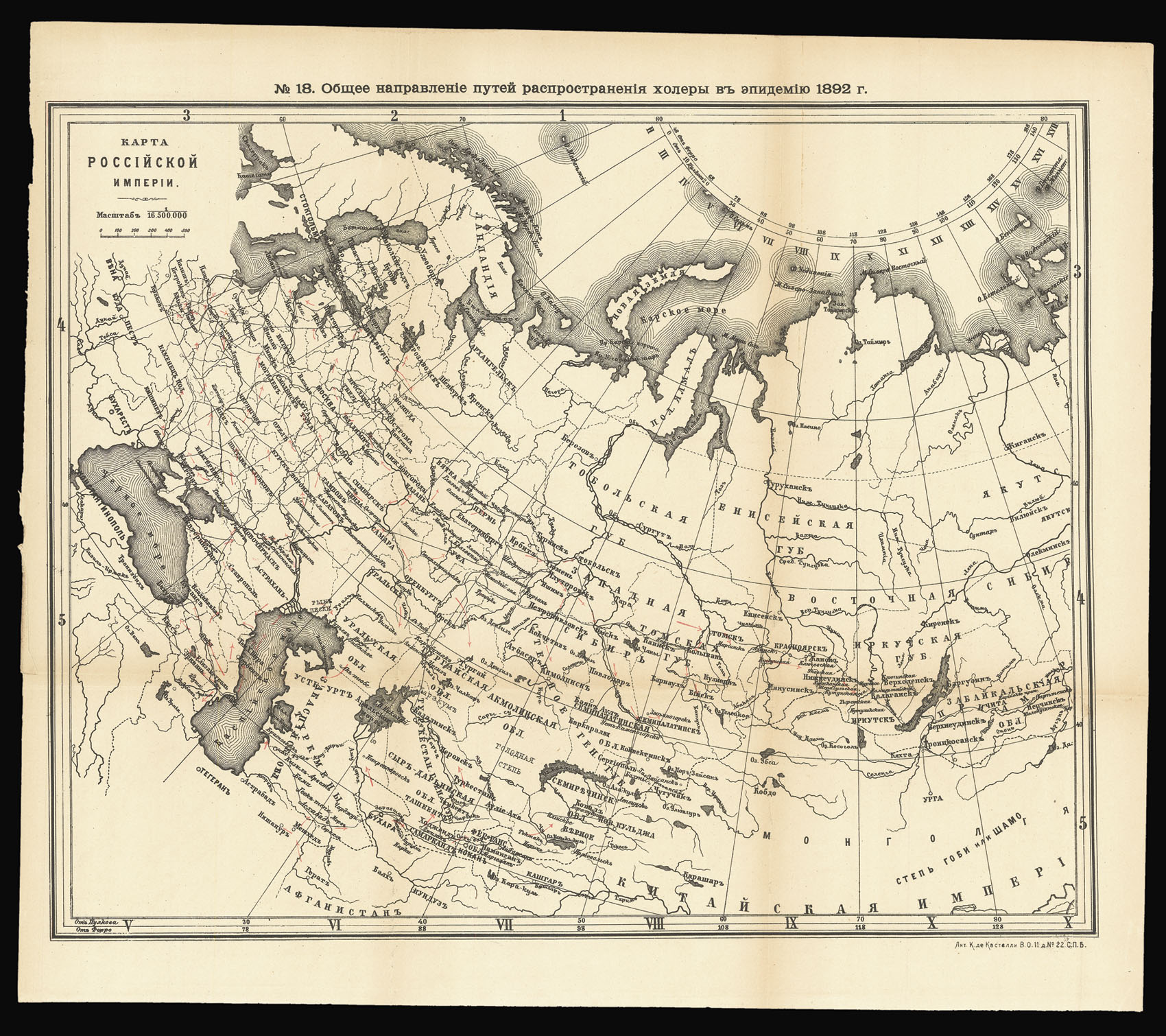
This image contains an epidemiological map depicting the spread of the 1892 Cholera Epidemic across Imperial Russia, which claimed hundreds of thousands of lives. The map is one of only a handful of Cholera maps to have been printed entirely in Russian Cyrillic, and was lithographed in St. Petersburg not long after the outbreak by C. de Castelli.
The map showcases both the western side of the Russian Empire and the eastern landscape up until Lake Baikal. On the map are a series of red arrows starting out near the Caspian Sea, where the epidemic first entered Russian territory from Persia through present-day Mashad, Iran. As an observer follows the red arrows from the Caspian Sea, it becomes evident that the Cholera cases were directly connected to waterway and railway systems further emphasizing the disease's infectious nature from a geographical standpoint.
From the Persian border, Cholera spread across the Caspian Sea, through the Caucasus region and then up across the Steppes to infect Kiev, Moscow, St. Petersburg and Warsaw. Castelli's use of the arrows visually conveys the chaotic nature of how the infection spread in many directions as it travelled from town to town. The map shows how the epidemic moved east across Siberia through several major towns and seemingly weakened as it travelled along with some areas being relatively untouched.
Despite the rural lifestyle and poor hygiene of some eastern Siberian towns, such as Irkutsk, they seemed to naturally avoid the intensity of Cholera due to higher quality of water and the natural dilution that might have occurred as Cholera travelled along major rivers like the Volga River out of the Caspian Sea. This was not the first outbreak of Cholera in the Russian Empire but it clearly had a widespread impact as depicted through this map.