A Map of the Trans-Siberian Railroad
Files
Title:
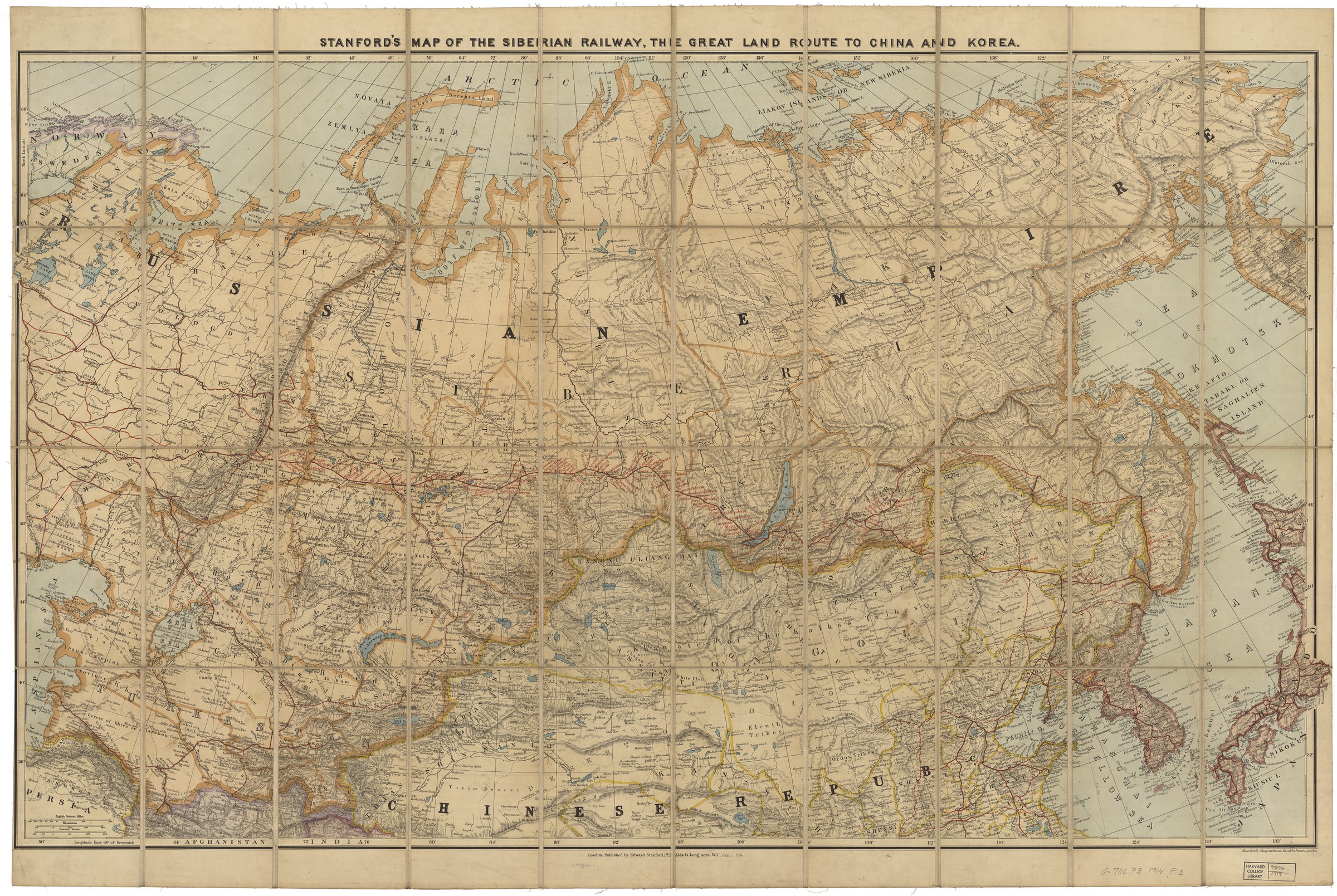
A Map of the Trans-Siberian Railroad
Subject:
A map of the Russian railroads through the European Russia, the Urals, Siberia, Mongolia, China and the Russian Pacific coast.
Description:
This is a map of the Trans-Siberian Railroad published in January 1914 by Edward Stanford in London. I am writing about the Trans-Siberian Railroad in Russia, and how it contributed to the spread of cholera during the epidemic of 1892. The Trans-Siberian Railroad is the longest railway in the world, stretching 5,571 miles from Moscow, in the center of European Russia, all the way to Vladivoskok, on Russia’s Pacific coast. It connects with the Chinese Eastern Railroad, which cuts across Mongolia.
The Trans-Siberian Railroad opened up parts of European Russia, the Urals, Siberia and Mongolia to increased economic development, trade, and settlement. Unfortunately, it also opened up previously inaccessible regions to the spread of deadly diseases, such as cholera. Cholera was sometimes spread by passengers who were unaware that they had the disease. While rivers in Russia were frozen over in the wintertime, limiting travel among them, railroads were operational year round, which potentially created the limitless spread of cholera.
This map shows the route of the Trans-Siberian Railroad, and adjoining railroads, such as the rail line that goes to St. Petersburg in northwest Russia. It labels all of the cities and towns that the railroad passes through. It also shows the neighboring countries to the south of Russia, some of which, like China, have connecting railroads, and Pacific nations such as Japan.
The map also shows the Korean peninsula, and Man-churia, where Russia was expanding into prior to the Russo-Japanese War of 1905. Port Arthur, Russia’s warm water port in China, is also shown on the map. As Russia expanded to all of these areas, it had to battle various levels of inadequate sanitation and local diseases. While the imperial Russian government may have battled with sanitation in remote Russian villages, there were probably even more sanitary problems in areas like Manchuria that were occupied by Russia after the Boxer Rebellion, but were not formally Russian territory.
Creator:
Edward Stanford.
Date:
January 1st, 1914.
Language:
English