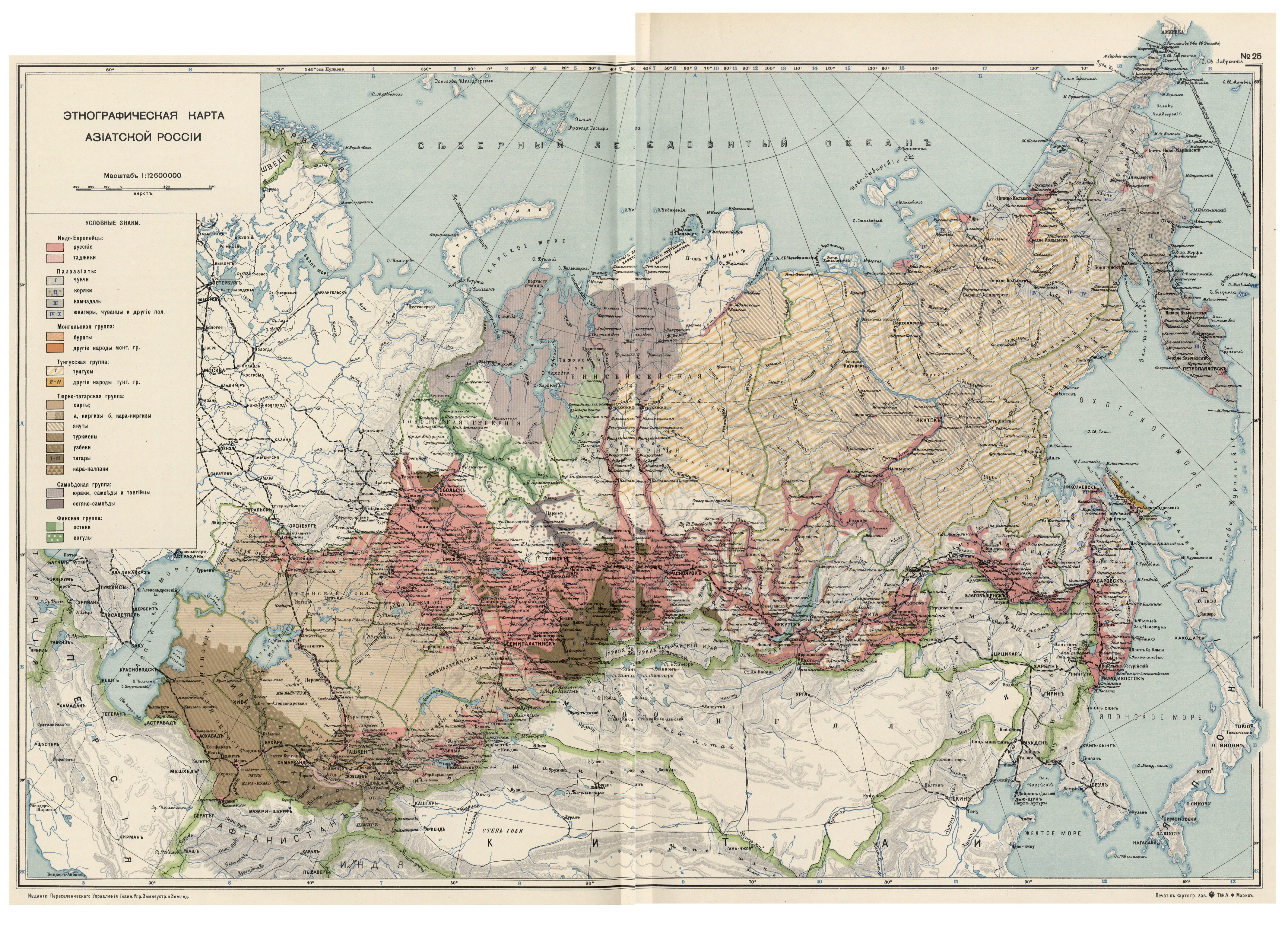
Etnograficheskaia karta Aziatskoi Rossii.
Files
Title:
Etnograficheskaia karta Aziatskoi Rossii.
Subject:
Ethnographic Map of Asiatic Russia
Description:
This map of Asiatic Russia tells the story of Russia's vast ethnic diversity. Just saying that the Russian Empire was diverse would be an understatement. Because of Russia's strategic location between Europe and Asia, it has come in contact with a large quantity of different peoples. There are over 120 different ethnic groups recognized in Russia today. The largest of them being Slavs or people of ethnic Russian heritage. This map shows the people groups of Asiatic Russia or Siberia. From the Turkic peoples to the south, The Chukchi in the northeast, and the Russian settlers in the center. The legend in the upper-left corner tells us that there are six ethnic categories and 21 groups (that this map includes.) The first category is Indo-Europeans which consists of Russians (Slavs), and Tajiks. It should be noted that Tajiks are considered by most as a Central Asian race and not an Indo-European race. The next category is the indigenous people of the far northeast region, next to Alaska. These groups are probably the furthest from traditional European Russian culture and these groups have much more in common culturally, Ethnicity and linguistically with Native Americans, especially the Native people of northern Canada. These groups are: Chukchi, Koryaks, Kamchadals, Yukagirs, Chuvans, and others. Both the Mongolian and Tunguska categories were mostly made up of one group. The Buryats for the Mongols and Tungus for the Tunguska. With some other smaller groups. The largest category is the Turko-Tatar Groups. The Turkic people in Central Asia and the Caucasus, according to this map, included: Tatars, Turkmens, Yakoots, Uzbeks, Kara-Kalpaks, Sarts, and Kyrgyzs. Many of the Turkic groups live in what is now modern-day Kazakhstan and Uzbekistan. Samoyed people groups not to be confused with the dog breed live in north-central Russia and this category consists of: Yooraks, Samoyeds, Tavgytsy, and Ostyak-Samoyeds. The last categories are the Finnish groups. The Finnish groups are very intriguing because they originated in Siberia around the Urals. Then some moved west onto the Scandinavian peninsula and the Baltics. The groups are Ostyaks and Vogels.
Creator:
Saint Petersburg, Russia : Resettlement Department of the Land Regulation and Agriculture Administration, 1914.
Date:
1914
Language:
Russian