Eric Hoppe Final
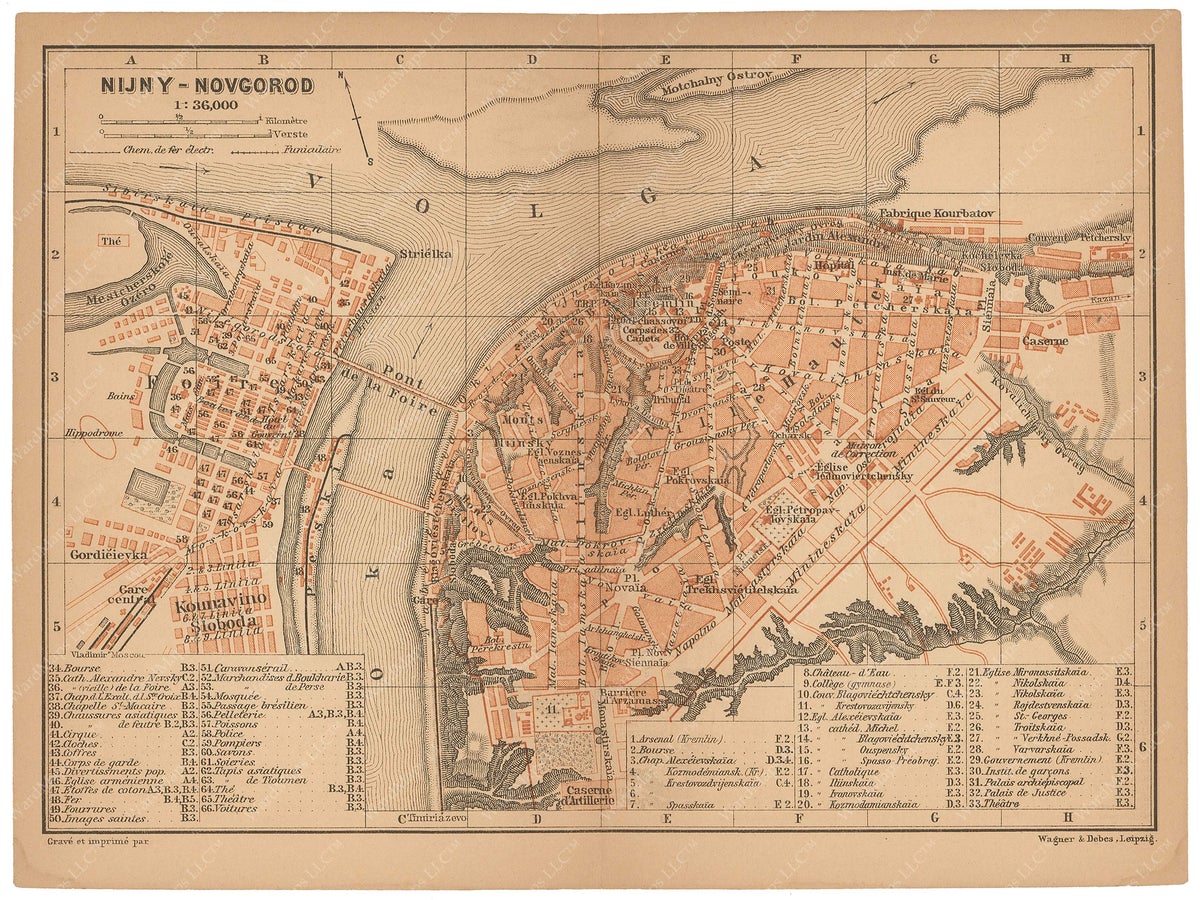
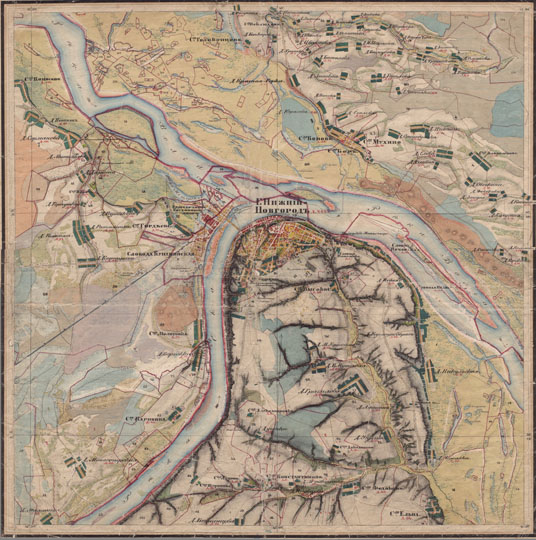
1st image Map of Nizhny Novgorod, 2nd image Nizhny Novgorod on A.I. Mende (Mendt) map
Files
Title:
Eric Hoppe Final
1st image Map of Nizhny Novgorod, 2nd image Nizhny Novgorod on A.I. Mende (Mendt) map
Subject:
1902 travelers map of Nizhny Novogorod city street plan and 1860 map of the general outline of the emergent cityscape of N. Novgorod.
Description:
“Cholera epidemics regularly spread up the Volga from Astrakhan, most devastatingly in 1892 and 1893 when the disease ravaged the working population of the fair. “
Description of Cholera entering Niznhy Novgorod in 1892 from Melnikov Ocherki, (1817–1917) as found in Ocherki’s Bytovoi Istorii Nizhegorodskoi Iarmarki
Thie primary map (a Baedeker map from 1902), shows the cityscape of Nizhnii Novgorod. It helps the audience to understand the spatial dimensions of Nizhnii Novgorod during the Cholera plague of 1892 during the time of the fair season. As is seen, Nizhnii Novgorod is split in half by the Volga River and was the primary transit point for goods, commerce, and people from west to east in the Russian Empire in the late nineteenth century. It was especially hard hit with the plague across all social classes – but especially the poor and disenfranchised. Sanitation, clean water and provisions for the citizens were all conflated in this urban space. In looking at this map (and the secondary map) we will look to learn about the history of the people who sought to maximize their health and chances of avoiding Cholera by relying upon advancements of Imperial state’s-built environment. That is, was creating walls and defensive spaces like cordoned areas, bridges, hospitals, quarantine areas provided protection of the local inhabitants was effective? From this the map hopes to give the audience clues and insight into whether was it possible to fence off a Cholera Epidemic in 1892 in a Russian Imperial city of Nizhnii Novgorod? Sadly, the answer is no. But we do learn that the difficulty of securing the city or eliminating the spread was going to be a challenge irrespective of outcome and ,when compared to the second map, is that a silver lining to Cholera might be the creation of order and a more measurable and defined built environment as Imperial Russia sought to modernize.
Creator:
Maps by Wagner & Debs, Leipzig Austro-Hungary Empire, A.I Mende Saint Petersburg, Russia
Source:
1st map Karl Baedecker's 1902 map of Nizhny Novgorod, 2nd map A.I. Mende (Mendt) map as requested by and organized for the Tsar's Military Topographic Depot of the General Staff, the Land Survey Department and the Russian Geographical Society
Publisher:
Karl Baedecker, A.I. Mende
Date:
1902, 1860
Contributor:
Artist Statement - Eric Hoppe
As a graduate student at Harvard, I am nearing the completion of a class focused upon viewing Imperial Russian history through the lens of maps. From this class, I have found myself venturing from the pragmatic world of Statist development to a world imbued with metaphysics and back again to make sense of the cosmology and eschatology of my experience. I find myself pondering questions, unsure if answers exist. I find puzzles with interlinking meaning in 2D vectored cartographic space with scalars of additional maps and legends and historical events adding context and nuance to what I see in a map that I might look at. I am confused, entertained, and enlightened, as I detail below. First, though, I want to share why I decided to pursue this presentation. And why, specifically, I chose these maps and why I selected the sources that inform their relevancy.
Concerning the map(s) and accompanying texts to my presentation, I see commonalities of locations, events, and time now and in the past. For example, I view the JFK airport in New York City in the time of Sars Covid 2 in 2022 in comparable light with Nizhny Novgorod in 1892 in the time of a Cholera Epidemic. Both are central intermodal transit points for people and goods and have faced serious challenges in maintaining control of health for significant portions of the population during an epidemic. No one is/was immune despite best faith intentions of governmental agencies and local authorities and physicians to make/made efforts to keep people healthy and free of infection with heightened sanitary measures. That there is also a considerable conversation about the methods of dealing with the epidemics, replete with ideas of conspiracy and non-compliance to governmental oversight makes this an intriguing coincidence.
To understand this historic doppelganger – I needed to answer a few questions: What was the built space of the period, and what was the built space in the intervening period, essentially at the time of the last epidemical outbreak of Cholera. Not to sound trite, but the only way to visually “see” this world, this place, at these times was with geographic maps of the period. My maps are a detailed tourist map by Baedeker from 1902 and an Imperially commissioned map from 1860. My primary sources are medical personnel reports and documents supported by secondary source material of experts in Russian history, the city of Nizhny Novgorod in the time period, and of the epidemic in question. The sources consider sanitation, hygiene, clean water, the communicability of Cholera, methods of conveyance, transmission, economics, class, cultural barriers and more. My questions had to be deep but narrow, meaningful but answerable, and I needed to learn something of the social and cultural character of the Russian people and the Empire under which they toiled. In the narration text that is attached to these maps, I believe you will find that the answers to many of these questions serve in equal measure of idea and ideology.
I hope that you too will enjoy this journey in these maps with me as an attempt to address the following questions: What defines a built space in Imperial Russia in the nineteenth century? Is it one that confines, protects, and nurtures like a womb or a cocoon with a platform for emergence, growth, and expansion? Is it something from nothing full of hegemonic energy? Is it a part of the natural world with the needs, hope, and ambitions of those who crave security and a source of certainty (inclusive of positive and negative outcomes) in a mercurially unkind and challenging place? Does the built environment of Nizhny Novgorod serve civic purposes equally among class, ethnicity, and social hierarchy? Did it serve its purpose in the time of the Choleric epidemic? Was it part of the problem or effective in its resolution of the contagion? In complete candor, though I tried to find answers to these questions, I continue to ponder many of these points.
Rights:
Public domain
Language:
French & Russian
Identifier:
56° 17' 47.4180'' N and 43° 56' 9.8088'' E.