Map of the rail, water and road routes of transport of European Russia. (Hyperlink)
Files
Title:
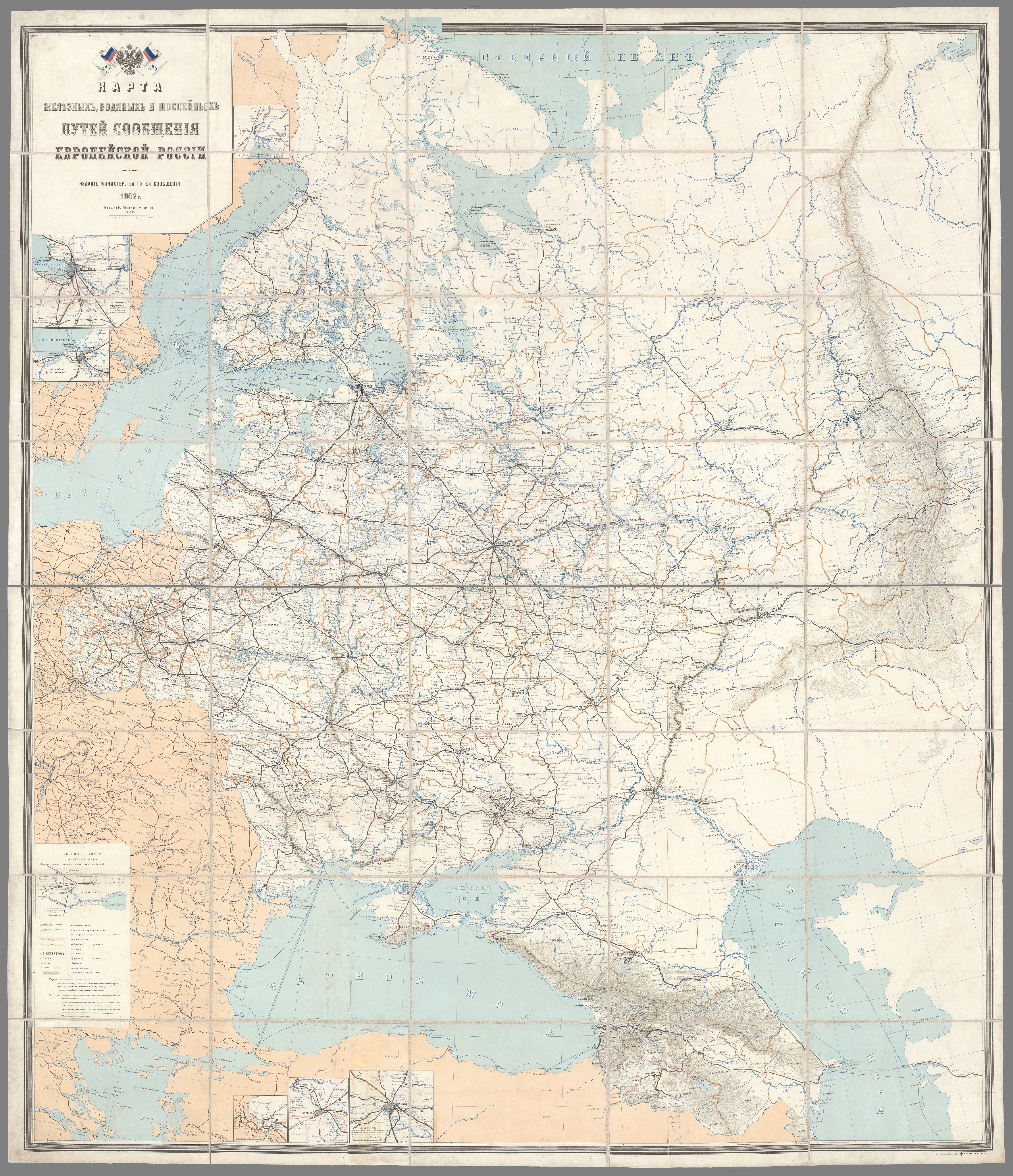
Map of the rail, water and road routes of transport of European Russia.
Subject:
A Map of the rail, water and road routes of transport throughout that of European Russia.
Description:
Issued by the Ministry of Transport in 1902, the Map of the rail, water and road routes of transport of European Russia, shows the massive growth in the rail network in the short time after the introduction of the locomotive to the Russian Empire. From 1830 to 1847 the Russian Empire expanded their railway from zero miles to 227 miles, and again from 1847 to 1892 expanded to 30000 miles with a majority of which is closely represented in this map of European Russia.[1]
Understanding the Map
Charted by renowned map maker A. Ilyin [2], this map details the different major methods of transport throughout European Russia at the turn of the Century. The map is marked accordingly:
- Large Solid Black Lines - Railways
- Orange Shading / Lines - Represent Provincial Borders
- Blue Shaded inland areas - Waterways / rivers
- Thin Single / Double black lines - Roads
- Thin Single / Double red lines - Highways
- Black Dotted Lines - Telegraphs
Relation to the Cholera Epidemic
This maps creation with close proximity to the 1892 Cholera epidemic also grants a reader with a better understanding of how the disease quickly spread throughout the Empire through its extensive travel infrastructure. The Western European regions are heavily connected to one another, granting quick access by not only travelers and citizens, but anything else which has the capability of travelling, such as a disease.
Notable Blanks in Service
On this map is key to note a number of locations had significantly less railway connection. For example, termination points in a number of large cities in the East. While cities like Kazan often served as gateways to east Russia, we see large swaths of land that see no connection at all to railways. Serving as termination points for rail service could result in losses of revenue, as exports only from the termination point city and travelers and locals specifically heading to Kazan finding themselves there. Other locations have railways going significantly further into eastern Russia. A key possibility is a level of influence held by one region over another, direct connections with the Russian government, or general corruption among those constructing the railways.
While termination points and / or lack of railway access would have been economic barriers to success, for these same reasons, the spread of the Cholera epidemic could be lessened. Fewer citizens and travelers to termination points could also reduce the likelihood of a town or region contracting the disease.
A notable blank in rail service is also along the Volga. Along the river there appear to be no less than Eight termination points. A possible shift from rail service to steamboat or water transport, inability to construct bridges over the Volga, or a general lack of economic neccessity could have been reasons for these terminations.
[1] Frank Clemov, The Cholera Epidemic of 1892 in the Russian Empire .. St. Petersburg: K.L. Rikker, 1893. 38
[2] As described by Professor O'Neill in her 1/19/2022 lecture
Creator:
Russian Ministry of Transport, Ilyin, A.
Source:
David Rumsey Historical Map Collection
Publisher:
Russian Ministry of Transport
Date:
1902
Rights:
https://hollis.harvard.edu/permalink/f/1mdq5o5/TN_cdi_lunacommons_luna_oai_N_A_RUMSEY_8_1_326865_90095479
Format:
JPEG
Language:
Russian
Identifier:
https://hollis.harvard.edu/permalink/f/1mdq5o5/TN_cdi_lunacommons_luna_oai_N_A_RUMSEY_8_1_326865_90095479
URL:
https://hollis.harvard.edu/permalink/f/1mdq5o5/TN_cdi_lunacommons_luna_oai_N_A_RUMSEY_8_1_326865_90095479